Some experiences confirm something you have always believed, but never quite been able to articulate. Being in Venice for the 61st International Art Exhibition of La Biennale di Venezia was one of those experiences for me.
I arrived in Venice on the 5th of May 2026, supported by the Africa-Europe Partnerships for Culture: Sub-Saharan Africa, Connect and Create mobility grant, funded by the European Union. What followed was one of the most formative times of my professional life, and it is the Tanzania story I want to tell first.
A Nation on the World Stage
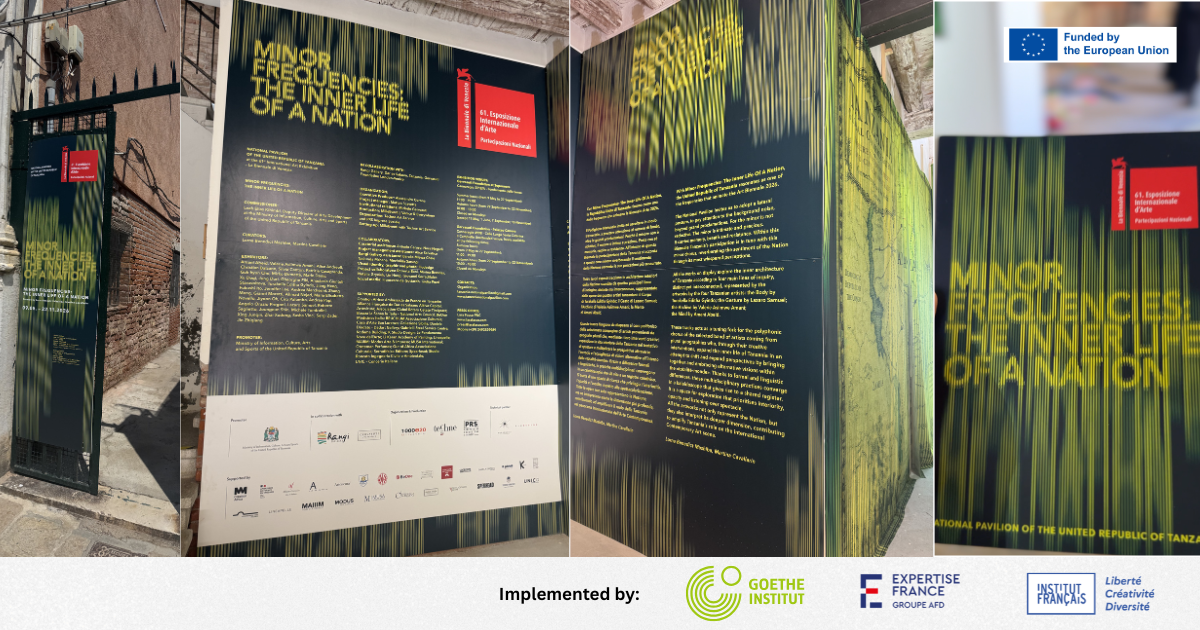
Tanzanian Pavilion Entrance and Catalouge
Tanzania's participation in the 61st Venice Biennale is our second time presenting a national pavilion at this extraordinary global event. For a country whose contemporary art scene is growing with real energy and ambition, that fact alone carries enormous weight. To be there, to witness it, to be part of it in whatever small way I could, felt surreal in the best possible sense.
The Tanzanian Pavilion, titled Minor Frequencies: The Inner Life of a Nation, was housed at the Gervasuti Foundation at Supernova in Cannaregio. The curatorial framework is quietly powerful. Rather than reaching for grand statements, it invites us to listen differently, to pay attention to what is intimate, what is whispered, what is often overlooked. The minor, as the exhibition's curatorial text beautifully puts it, is not reductive. The minor carries memory, breath, and resistance. For a country finding its footing on the international contemporary art stage, this felt like exactly the right posture.
The exhibition is built around four Tanzanian artists, each exploring the inner architecture of Tanzania through a distinct lens: the Body, through the work of Turakella Editha Gyindo; the Gesture, through Lazaro Samuel; the Archive, through Valerie Asiimwe Amani; and the Mind, through Amani Abeid. Their works act as a tuning fork around which a broader, polyphonic group of international artists gathered, expanding Tanzania's inner life outward into a global conversation.
The Artists I Have Watched Grow
What made this experience particularly moving for me was knowing these artists. I worked alongside each of them during my time as Visual Arts Programme Manager at Nafasi Art Space in Dar es Salaam. In this space, so many of Tanzania's most exciting creative relationships are forged. Watching them shine on one of the world's most significant international stages felt, honestly, like a dream I had not dared to dream too loudly.
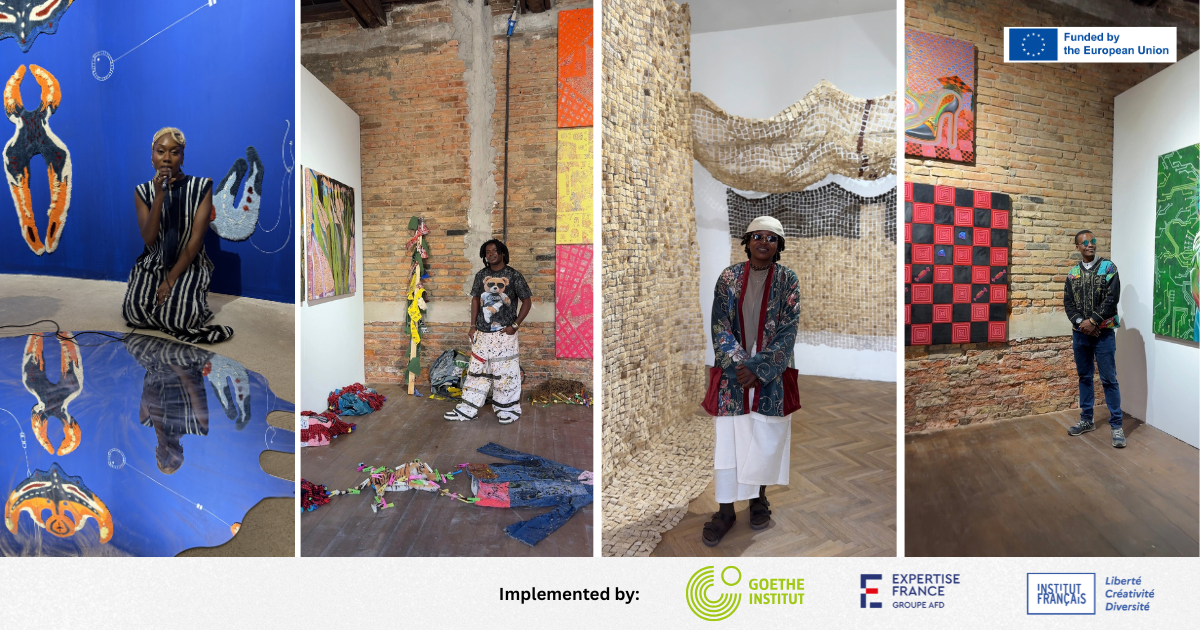
Tanzanian Pavilion Artists (left to right): Valerie Asiimwe Amani, Lazaro Samuel, Turaekella Editha Gyindo and Amani Abeid
Valerie Asiimwe Amani's presence at Venice felt deeply personal to me. She was one of the pilot artists of ARK, the Artists Residency of Kigamboni, the residency programme I co-founded along Tanzania's coastline. During her time at ARK, she produced a body of work that she later used to apply for her Master’s programme at Oxford University, where she is now pursuing her PhD. I have had the privilege of curating her work on two separate occasions, so to see her presenting under the theme of the Archive at one of the world's most prestigious art exhibitions was more than professionally satisfying. It was genuinely fulfilling in a way that is difficult to put into words.
Lazaro Samuel's journey to Venice is one of the most remarkable stories I have witnessed in Tanzania's art scene. We first crossed paths during my time at Nafasi, where Lazaro worked as a groundskeeper. His background as a former street child, combined with his daily immersion in Nafasi's creative environment, became the foundation of his artistic practice. He began working with the discarded and overlooked materials left behind by other artists in the space, finding his own voice through found objects and what others might call trash, transforming them into works of genuine beauty and narrative depth. Watching him develop from that starting point, through showing at the Stellenbosch Biennale, to standing in Venice has been a full-circle moment that I will not forget. His story is a testament to what becomes possible when talent is given space and time to grow.
Turakella Editha Gyindo is someone I first met when she enrolled at Nafasi Academy to study curatorial practices. Even then, there was something in how she approached art, not just as an object to be made, but as a language to be mastered and communicated. Over the years, I have curated group exhibitions that included her work, and the growth I have witnessed in her medium, her storytelling, and her confidence has been wonderful to observe. She has since completed international residencies around the world. What strikes me most is how, wherever she is, she works hard to ensure her practice remains accessible to fellow Tanzanians through social media. You can see the lessons of her curatorial training in how she presents her work, with intention and care. Seeing her body of work presented in Venice under the theme of the Body was a proud moment.
Amani Abeid is an established artist whose presence at Venice felt like the natural culmination of years of hard work and consistency. We worked together at Nafasi, where he was one of the member artists, and one of the qualities I have always admired in him is his extraordinary ability to communicate his work. Whether speaking to collectors, fellow artists, or first-time art lovers, he has a gift for opening up his practice in a way that invites people in rather than keeping them at a distance. It was wonderful to see that same spirit present in Venice, as he brought his work exploring the Mind to an international audience that clearly responded to it.
Together, these four artists carried Tanzania into Venice with grace, depth, and ambition. For me, having known each of them across different chapters of my own career, watching them stand on that stage was one of the most surreal and joyful experiences of my professional life.
A Story of Resilience Behind the Scenes
What the world sees when it walks into a national pavilion is the finished work, the carefully considered space, the art that stops you in your tracks. What it does not see is everything that had to happen to make that possible. This year, the Tanzanian Pavilion's journey to Venice included a chapter that tested everyone involved.
Six weeks before the opening, the lead curator changed. The original curator had worked hard to bring the pavilion together. Still, amid fundraising difficulties in the aftermath of the October 2025 elections, she was unable to secure the resources needed and decided to step down. Lorna Benedict Mashiba, co-curating alongside Martina Cavallarin, stepped in and had to raise funds, reconfigure the curatorial vision, confirm artists, and mount an entire national pavilion in under two months.
What she achieved is nothing short of remarkable. Watching that process from the inside, understanding the sheer volume of decisions, negotiations, logistics, and creative judgements that had to be made at speed, taught me more about what it truly takes to realise a national pavilion than any book or course ever could. Lorna's determination, clarity, and grace under pressure were deeply admirable. Working alongside her has opened new doors for me and given me a much sharper understanding of what Tanzania's future at the Biennale could look like.
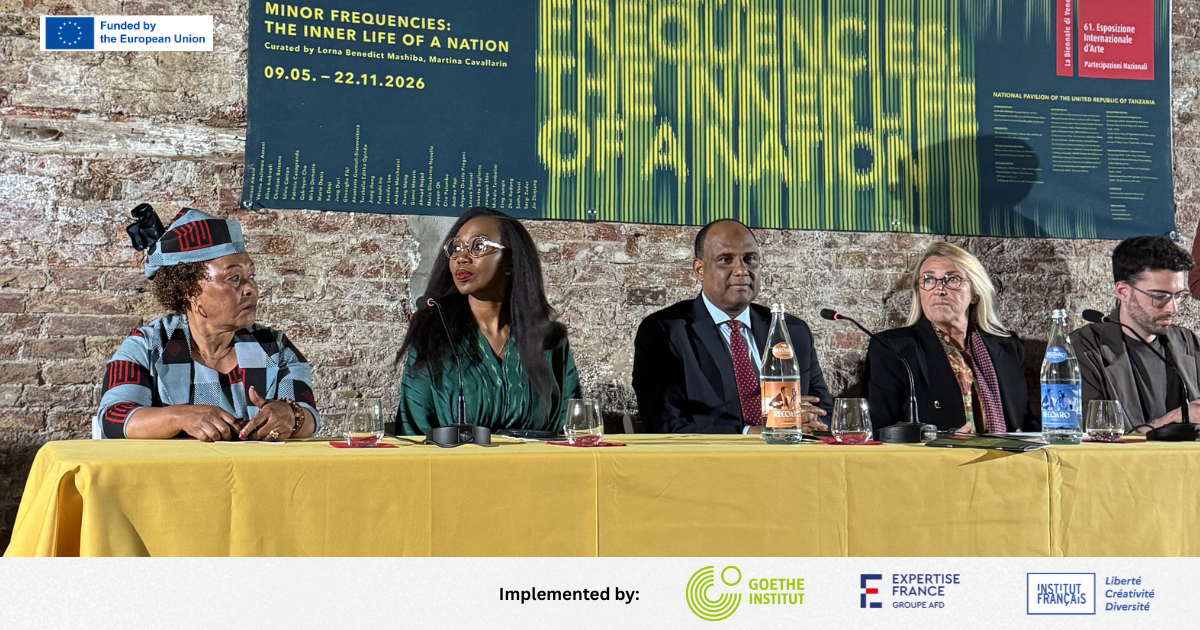
Tanzania Pavilion Opening Ceremony (left to right): Leah Elisa Kihimbi, Deputy Director of Arts Development at the Ministry of Information, Culture, Arts and Sports of the United Republic of Tanzania (Commissioner), Lorna Benedict Mashiba (Curator), H.E. Mbarouk Nassor Mbarouk, The Ambassador of the United Republic of Tanzania to Italy, Martina Cavallarian (Curator) and Matteo Scavetta (Project Manager)
What This Means for the Future
Tanzania is building something. The fact that we are back in Venice, presenting a thoughtful, ambitious, and genuinely moving pavilion, is a statement of intent. The challenges we face with funding and institutional support are real and not unique to Tanzania. But the commitment of the artists, curators, and supporters who made this happen proves that the will is there.
For me personally, this experience has clarified a direction I had been moving towards for some time. The relationships built, the lessons learned, and the time spent understanding what this process demands have all been invaluable steps on that path.
The Africa-Europe Partnerships for Culture grant enabled me to be present for it all. Not as a distant observer, but as someone embedded in the experience, learning from the inside. For that, I am deeply grateful.
Minor frequencies, as it turns out, can carry the loudest truths.
This mobility was supported by the Africa-Europe Partnerships for Culture: Sub-Saharan Africa, Connect and Create programme, funded by the European Union, implemented by the Goethe-Institut, Expertise France and Institut français.